


ECO²SCAPE
ECO²SCAPE (October 2020 – March 2025) aimed to bridge science and practice by developing co-designed, future-oriented solutions for biodiversity conservation in agricultural landscapes. The project brought together ecological, economic, and social perspectives to create practical pathways toward sustainable land use. The project was recognized as an “outstanding example” for the UN Decade on Ecosystem Restoration, honoring its transdisciplinary and innovative research approach.
Funded through the BMFTR Research Initiative for the Conservation of Biodiversity (FEdA), ECO²SCAPE was coordinated by our team (formerly based at TU Dresden) in close collaboration with research institutions and practice partners, including BTU Cottbus-Senftenberg, the Leibniz Centre for Agricultural Landscape Research (ZALF), Landschaftspflegeverband Nordwestsachsen e.V., and Nationale Naturlandschaften e.V.
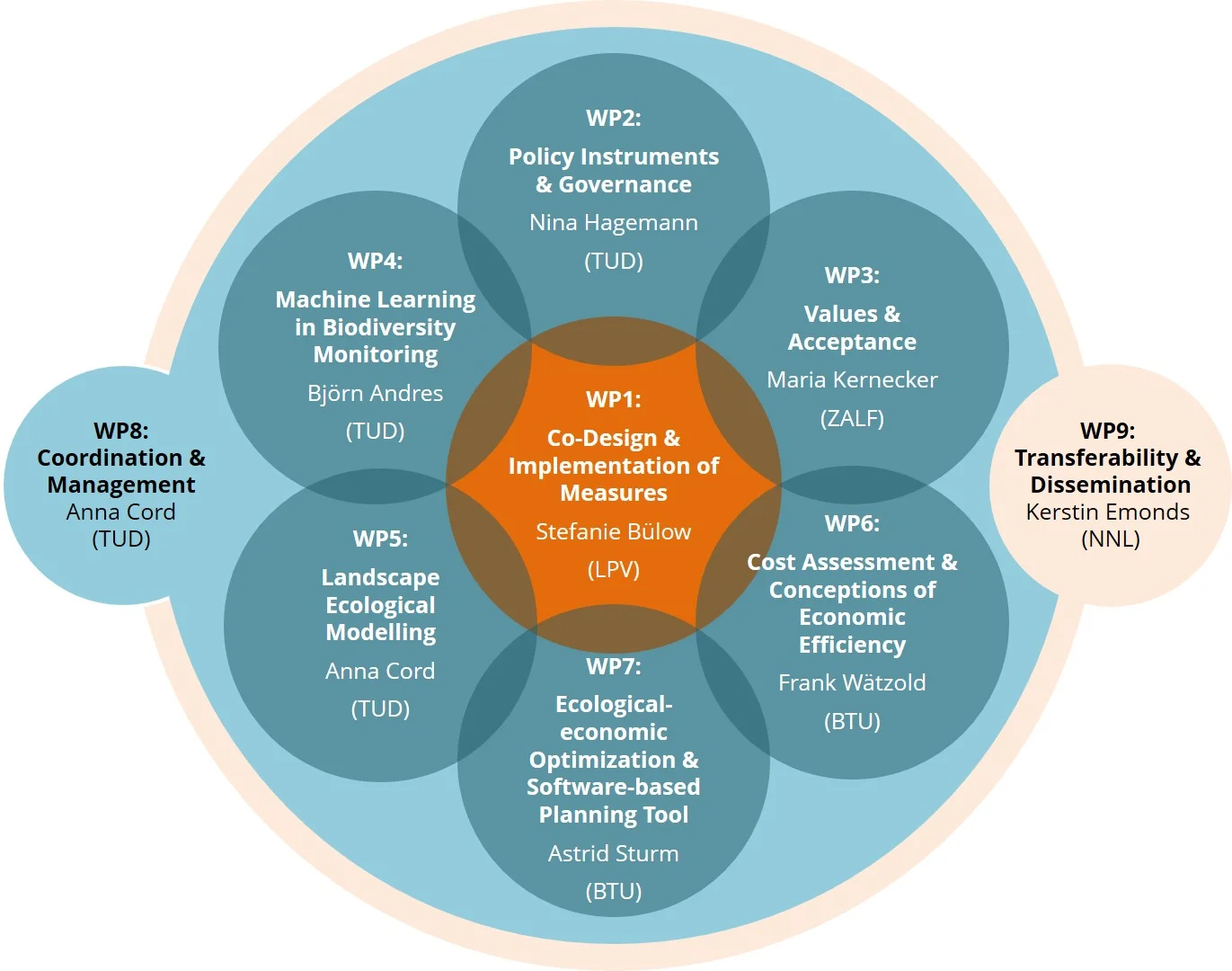
ECO²SCAPE combined methods from agricultural sociology, political science, landscape ecology, machine learning, and environmental economics within a transdisciplinary framework . This approach enabled the integration of diverse knowledge systems to jointly develop practical, solutions for biodiversity-friendly agriculture. Our study region, the Vereinigte Mulde in North Saxony, forms part of the field of action “Altkreis Delitzscher Land” managed by our practice partner Landschaftspflegeverband Nordwestsachsen e.V. The region is characterized by intensive yet diverse land use, includes biologically unique protected areas, and can serve as a representative model for other German cultural landscapes.

The project included the following key aspects:
- Co-design: Collaborative development and pilot implementation of biodiversity measures together with local stakeholders
- New technologies: Use of passive accoustic monitoring and machine learning for species detection
- Participation & acceptance: Social science research on the values, perceptions, and acceptance of biodiversity measures among farmers and the public
- Optimization tools: Development of economic-ecological models and planning software for efficient implementation and farmer advice regarding agri-environmental measures
- Spatial analysis: Modeling the ecological effects of agri-environmental measures across landscapes
- Policy innovation: Exploration of result-based payment schemes and their integration into existing policy instruments
- Transferability: Exchange of developed concepts with biosphere reserves in other areas in Germany
Further information, including all publications, is also available here.
Funding